



Vinyl vs. CD: which is right for your release?
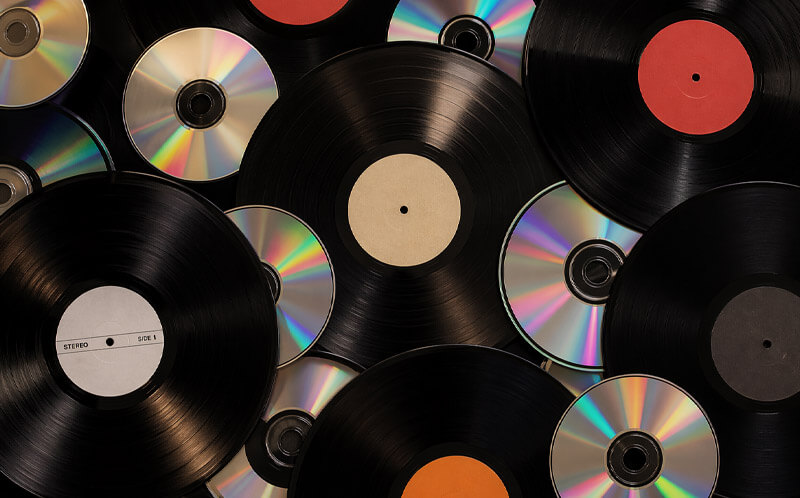
If you were to ask one hundred random people whether they'd choose vinyl vs. CD for a release, you're likely to get a host of answers across the whole spectrum of preferences. The question at hand isn't that one format is retro while the other is a relic, but rather which one is designed to suit your specific audience, needs and budget.
The independent artists who match the format to the release in front of them are the ones who get the most out of a physical release, not the artists who are simply chasing whichever format is trending right now.
Vinyl gets a lot of favorable hits from the press because of its original comeback story, which can make it easy to assume that CDs are a fallback option for artists who can't afford the "real" version. That's the wrong way to look at the vinyl vs. CD debate.
Each format solves different problems well, and the release that we need to solve the vinyl vs. CD question for is your own. Read on to learn more about what actually separates the two, backed by real numbers, so that you're not left guessing.
The difference in cost is substantial
Let's talk cost first and foremost. This is a realistic way to end the "vinyl vs. CD" debate before it even begins. At Disc Makers, we've broken down the profit potential for both vinyl and CDs. CDs generally cost $1 to $2.50 per unit to manufacture, whereas a 100-unit vinyl order runs $10 to $15 per record. That difference narrows somewhat at higher volumes, but even 300 to 500 vinyl orders still cost around $5 to $7 per record.
We've broken down the economics of pressing vinyl to make it easy to estimate at-a-glance: a 100-unit run costs $999 for the pressing itself, and around $1,169 (around $11.69 per record) once you factor in a barcode and shipping.
CDs get even cheaper at scale. Disc Makers' own breakdown of how much CD replication costs shows that a basic CD package running at $1.00 per disc at 1,000 units drops down to around $0.70 at 5,000.
Vinyl doesn't follow that same downward curve because pressing vinyl is a more involved process. The vinyl pressing professionals have to cut a physical lacquer and run a mechanical press rather than injection-molding or burning a disc. That craftsmanship is an integral part of what a fan is paying for when they buy a record.
But cost alone shouldn't be the only consideration to keep in mind. It's worth having an honest conversation about, to be sure, but it's also worth thinking about what that extra cost buys you beyond chalking it up to "the cost of manufacturing." What you're really getting is a higher retail price that fans are happy to pay, alongside an object with which fans have a very different relationship compared to CDs. That's why investing in both can be worth it if you know how your audience will respond.
Turnaround time is where things get serious
Vinyl pressing takes approximately seven to nine weeks as the standard, with faster options available, although no guarantee that they'll line up with a specific release date booked on short notice. CD duplication works on an entirely different clock. For short-run CDs, the turnaround time can be as little as one day, with most orders shipping in around four days.
That's an important distinction to make, because one format can respond in days to a decision you made last week, while another has to be planned around months in advance. If you're announcing a tour in six weeks, and you want merch ready to sell, vinyl is off the table unless you've already planned out your order beforehand. If you're dropping a surprise single and want something physical at the merch table by Friday, CD duplication is the format designed for it.
Sound quality doesn't mean vinyl wins by default
There's a common saying among audiophiles that vinyl sounds warmer and CDs sound cleaner. There's truth in both statements once you understand more about how each format actually works. Because a CD is digital and has no physical constraints in terms of playing time and volume, it can hold 74+ minutes at a consistently loud volume across the whole album.
Vinyl works differently, and if you're interested in learning more about how to compare vinyl and CD sound quality, it's worth checking out the details. In short, a vinyl side cut at true maximum volume tops out at around 18–19 minutes. A mastering engineer will pull back the overall level just a hair in order to fit more music into the same physical groove when a side runs longer. That's a mechanical constraint of how the format works, and the professional mastering engineers at Disc Makers work with it often as a matter of course. That's also why vinyl mastering is its own specialized craft.
What vinyl gives you in return is something that CDs can't: the specific character of analog playback, and a listening ritual that many fans associate with enjoying an album on a deeper level than what you can get with passive streaming. In comparison, CDs offer something that vinyl can't — uncompromised consistency across the whole album, no matter what the runtime is or how bass-heavy the mix is.
Neither format is the more "accurate" one, nor do these things make one format or another the "compromise" you have to deal with. The trade-off is that you have to know what your audience responds to, since each format rewards different kinds of albums. A sparse, dynamic record with breathing room will work beautifully with vinyl because there's less low-end demanding groove space and more headroom to work within the format's limits.
A dense, bass-heavy, or unusually long album, on the other hand, is better served by CD specifically because there's nothing about it that needs to be compromised on in order to fit a fixed physical side. Understanding which category your release fits into is worth knowing before you simply click a box and move on.
Durability favors both CDs and vinyl, but only if they're made right
Now let's talk about durability, since the details often surprise independent artists and listeners alike. A properly pressed CD and a well-made vinyl record have nearly identical lifespans. If you've ever been curious about vinyl record lifespans, you'll be interested to know that its makeup is what makes it last. Vinyl, made from PVC, can last over one hundred years with reasonable care.
A professionally pressed CD has a lifespan of around one hundred years as well. The format that falls short in this case is the CD-R (a burned disc rather than a pressed one). These discs tend to last around twenty years before "disc rot" sets in. Disc rot happens when the delicate reflective aluminum layer oxidizes, or when the adhesives that bond the layers break down, making the disc unreadable.
That difference matters for a decision that many independent artists don't realize they're making until it's too late, understanding the difference between CD replication and duplication. The same injection-molding process used for retail CDs is available starting at around 500 units. Smaller runs are duplicated onto high-quality blank media instead. The audio quality is identical, but if long-term durability is a must, then knowing how your CD order will be processed is crucial rather than just assuming that "CD" always refers to the 100-year type.
Where is the cultural momentum sitting right now?
So far we've talked quite a bit about differences in format in terms of sound, physical constraints, pricing, and turnaround time. One area we haven't touched on is market context, and it's important. Our recent look at vinyl record sales trends shows that vinyl sales have grown for sixteen consecutive years, outselling CDs for the first time since 1988. In fact, U.S. listeners spent around $1.2 billion on vinyl in 2022 alone.
Most fans who buy vinyl do so for reasons that have nothing to do with the playback itself. They want an object they can display, or they want to support an artist directly. CDs, meanwhile, score top marks in affordability. They still play in cars without Bluetooth and the cost is low enough that a fan can grab one on impulse for $10 and have a physical product that connects them to the launch, the artist, or the show. Although streaming is extremely popular, CDs are catching up, and having that clean, portable sound can go a long way, especially with new fans.
What is each format actually selling at the merch table?
It's worth noting that the vinyl vs. CD debate isn't about two formats strictly competing for the same dollar. For those independent artists who sell merch at concerts, vinyl is still one of the most consistently popular items along with apparel simply because it's as much a display piece as it is a listening format.
CDs also serve fans, but in a different way. For those fans who want something to play immediately, gift to others, or want something they can buy without hesitating on price, a CD is an easy yes. Some of the most successful merch tables carry both so that they can serve two different segments of the same room.
Which one should your release use?
Vinyl vs. CD sounds like an abstract debate on the surface until you end up spending hours doing comparisons online. That's why we created this guide to help you narrow down your options. Sit with each one of the questions below for a moment, because their answers can completely change the decision you ultimately make.
How much lead time do you have?
This is the most decisive question at all, because the answer can be "three weeks" which isn't nearly enough time to get your files mastered and preview your proofs, let alone start production on your vinyl records.
Of all the questions, this one also has the least wiggle room. If the physical records need to be in hand in less than two months, whether that's for a tour, a release show already booked, or a deadline that's otherwise out of your control, vinyl's standard 7-to-9 week standard turnaround time makes the decision for you regardless of what you might want. In contrast, CD duplications multi-day turnaround exists precisely for this reason; creating a release that comes together faster than it ever could with vinyl.
How much of your budget can you put into a physical product?
A $1,000+ vinyl order is a serious commitment for most independent artists, and you'll want to ask yourself whether that money is better spent on 100 records, or divided among mastering, promotion, and a smaller CD run that still gives every fan something to hold.
There's no wrong answer to this question, but there is a wrong way to arrive at one – by deciding based on which format feels more exciting to announce rather than what your budget and timeframe can reasonably handle. You know your audience better than anyone. Ask yourself what they're asking for when it comes to the best ways to enjoy your music, and then decide accordingly.
What do your fans tell you they want versus what you assume they want?
If your mailing list has been asking for vinyl across your last two releases, or you've got people coming up at merch tables asking "Do you have this on vinyl?" then yes, you've got a real, specific demand worth answering. A fanbase that mostly discovers you via playlists, rarely comes to shows, and has never brought up wanting physical formats tells you something too – that a lower-cost CD run gives them something they can hold or add to their cart quickly as a bonus, over a $25+ collector's item they're not particularly interested in either way.
What type of release is this?
Releasing a quick single or a stopgap EP between full-length versions can rarely justify the cost of investing in vinyl, not to mention the lead time. Vinyl tends to reward a substantial body of work to the point where the release feels like an event, not just a couple of songs released as a teaser. For that, CDs are your best option. They're quick and easy to manufacture while giving fans something tangible they can listen to right away.
A debut full-length, career-spanning anniversary release, or a concept album that's meant to be experienced as an artistic statement are the kinds of releases where vinyl format constraints become an asset rather than an obstacle because they propel you toward exactly the kind of intentional sequencing that an impactful album rewards.
Are you selling directly to your own audience or via physical retail?
Each of these options will pull you in different directions. If part of your plan involves getting into local record stores or working with a distributor, you likely need a vinyl run that's designed for maximum shelf presence, since having just a handful of records won't give a store enough to meaningfully display your work the way it deserves to be shown.
If, on the other hand, your physical sales are all direct – whether that's through your own website, merch table, or mailing list, then the pressures of retail don't apply to you, and you can trust in a smaller, tighter run of either format, sized to your actual audience. This is a much better option than padding a quantity of records for a distribution channel you're not even using yet.
What point are you at in your career?
If you're an emerging independent artist testing whether or not physical music resonates with your audience, you have less to lose with a modest CD run. It's inexpensive enough where you can be generous with it, and fast enough to have the CDs ready for the next show. It's also low-risk and an excellent way to test the waters before you commit to more.
Likewise, if you're an artist with a proven track record, an established live audience to draw upon and evidence from prior releases that your fans buy physical music, you're in a position to make vinyl pay off, because you're backing it with your previous sales history.
Neither of these decisions have to be either/or, and asking yourself the above questions may not always give you a single, clear winner. Sometimes the answer really is "both." Plenty of artists press a short vinyl run for fans that want the whole experience, while also doing a CD run for its low-cost accessibility and faster turnaround time. You can always invest in a vinyl pressing after a modest CD run, once the initial sales have proven to be profitable.
Getting started with a CD and vinyl pressing manufacturer
Deciding between CD vs vinyl for your release isn't an easy question to answer. In this guide, we've given you the big picture on the cost, timeframes, and details of vinyl vs. CD. However, it's one thing to give you an overview and another thing entirely to let you see a custom quote with your own details added.
That's why you'll be glad to know that Disc Makers offers free quoting tools for both vinyl pressing and CDs. Both online quote tools let you plug in your actual quantity, jacket style, and packaging choices for each format, and then see them side by side. This way you can get a direct comparison for your specific needs rather than a decision based on industry averages.
If you've asked yourself the questions above, and your honest takeaway is "both," Disc Makers even has a package created just for independent artists like you. Our vinyl and CD combo package combines 100 vinyl records and 100 CDs together for $1,199. This puts the pricing close enough to a vinyl-only order that you can easily reach both audiences without having to double your budget.
Our vinyl and CD combo package is designed precisely for those artists who want something they can sign and hand to the fan who wants a collector item, as well as something affordable and instant for the fan who just wants to take the music home. However you ultimately decide, Disc Makers is here to help you turn your specific needs into a combination of format, quantity, and packaging that fits your release schedule.
If this is your first time ordering vinyl or CDs, you'll be glad to know that our helpful support doesn't just end with our free quote tool. Our sound engineers and formatting specialists have decades of experience whether you need professional mastering, mixing, or production. We also work with artists on staff to help bring your vision for your packaging to life, and we handle the logistics of shipping to get your music where it needs to go.
Contact us today to learn more or start the free quote process. Our support staff is on hand to answer any questions you may have or to walk you through the ordering process. We invite you to browse our full library of educational articles that run the gamut from handling copyright and licensing, to common pitfalls that trip up even the pros. Start today and you could have your release in-hand and ready to release faster than you ever imagined.