



How much does it cost to press vinyl?
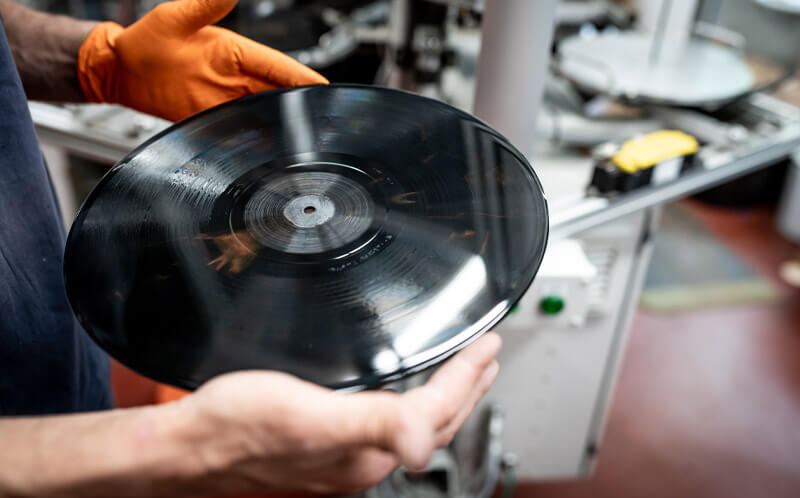
If you've ever done a quick search for "How much does it cost to press vinyl?" you've likely come away with answers that range from a few hundred dollars to several thousand. Those numbers come with no explanation for why they're so far apart. So why the inconsistency?
The truth is that there are several different variables that get lumped into a single question. A hundred black 12-inch records in a simple jacket and a hundred colored double LPs in a gatefold with premium finishing both fall under "pressing vinyl" and they can be thousands of dollars different before you've even pressed a single copy.
Fortunately, the cost to press vinyl isn't a mystery once you break it down into its actual parts:
- A basic manufacturing cost that scales the more you add
- A handful of optional upgrades that each carry their own price tag
- Surrounding costs that include mastering, design and shipping
Some of these are easy to forget until they show up on an invoice, but none of them are particularly complicated. Most quotes around the cost to press vinyl won't lay it all out for you in one place, which is exactly why we've created this helpful guide. Learn what pressing vinyl actually costs, piece by piece, and what that investment buys you.
The starting number and why it's a range
For a straightforward 12-inch pressing, Disc Makers' vinyl pressing cost page gives you real numbers to start with: 100 records in Euro jackets start at $999. The same quantity in a standard jacket with a printed spine costs $1,199. Both include 140-gram vinyl, full-color label printing and a plain inner sleeve.
These options give you a complete, professional package rather than leaving you with a stripped-down starter option. If you're interested in 7-inch pressings with the same 100-unit minimum, you'll get even more affordable pricing.
As you can see from the breakdown between $999 to $1,199 as a starting range, the format and jacket style you choose change the price before you've added on a single customization option.
Choosing a deluxe package with colored vinyl, a gatefold jacket, and heavier 180-gram pressing increases the cost, and for those, we quote individually rather than giving you a default number, simply because there are so many color, weight and packaging combinations, that putting a single sticker price just wouldn't be accurate.
What that money pays for
So what exactly are you getting for that price, and why does vinyl cost more compared to a CD run of the same type? Through Disc Makers' breakdown of CD vs. vinyl profit potential, you'll see that CDs typically cost anywhere from $1 to $2.50 per unit to manufacture, while a 100-unit vinyl order runs $10 to $15 per record.
The difference is that a CD is produced by injection-molding a disc from a digital master. This is a process that's highly automated and fast. Compare that to the process to press a vinyl record: the record is cut from a lacquer, placed into a metal stamper and pressed one at a time on a mechanical press that is doing real physical work on each disc. As such, the process is slower and much more hands-on, which means the price reflects that extra craftsmanship and effort.
That cost curve also improves with scale, as is the case for most manufacturing. For example, a 300–500 unit vinyl order brings you per-record cost down to $5 to $7 per record. To illustrate, a 100-unit order at $999, plus around $20 for a UPC barcode and $150 shipping, costs around $1,169 total, around $11.69 per record once you factor in all of the costs, not just the vinyl pressing itself. At 200 units, you'd pay just $8.80 per record and at 300, $7.60.
The costs that fall outside the base package
Most artists understandably focus on the manufacturing quote, but that's rarely the only cost you'll budget for. The costs that fall outside the base package are the ones that often matter most for a more accurate total. Those include:
Mastering
With professional mastering starting at just $49 per track, it's worth adding on if you're mastering a 10-track album from scratch. It's easy to forget the mastering process, especially when you're comparing the core vinyl pressing quote against your budget. Since vinyl mastering requires its own expert touch, it's worth budgeting in a little extra for this highly-recommended service.
Artwork and design
You don't need to find the best vinyl record artist to handle your artwork and design when the team at Disc Makers can handle it for you. Our experienced on-staff graphic designers have decades of combined experience working in both print and digital media, with album design services starting at just $299.
If you already have your own finished, print-ready artwork, our detailed album design services are worth a look.
UPC barcode and shipping
Two small individual costs, but worth remembering when figuring out the cost to press vinyl. Your UPC barcode opens up a wide range of promotional possibilities, from helping you track physical purchases and digital streams, to unlocking distribution on digital platforms like Apple Music or Spotify.
Test pressings
Test pressings take up a different place in this list. We include five test pressings standard, particularly on deluxe and double LP orders, as well as orders over 500 units. Keep in mind that a test pressing cycle adds around two weeks to the production timeline, which makes this a scheduling cost more than a dollar one, but if your budget planning is tied to a release date, it's worth noting.
A little preparation protects the budget you've committed to
There's one more cost to understand before you start the order process, and it has nothing to do with vinyl, color, or jacket style. It's the unforeseen cost of getting the details wrong the first time.
That's precisely why test pressings exist: so that you can catch problems early before a full run presses them into your vinyl records. Think of test pressings as a quick checkpoint that protects your investment, particularly when you're investing a lot up front. If an issue crops up and you need a second round of test pressings, that will add a few hundred dollars to the cost. Artwork changes made after test pressings have shipped also carry their own reprinting cost for that same reason. When physical materials are already in motion, having to stop and go back can be costly.
That being said, none of this is a reason to feel particularly anxious about the process. If anything, preparation is worth the time you give it. Spending a little extra time getting a master, a track listing, and finished artwork locked in and double-checked before hitting submit will not only keep the rest of your budget landing exactly where you planned it, but keeps your timeframe on track as well.
What do upgrades cost? What do you actually get?
Now, let's talk about upgrades. Vinyl customization options are what makes a record feel like a true collector's album, and if you're looking to customize yours, it's a good idea to know where each choice adds cost and why.
For example, colored vinyl is available for a modest upcharge over standard black, and it's a small premium to pay so that your record doesn't look like everyone else's on the shelf. Splatter and marble effects, 180-gram weight, and gatefold jackets are also available as further upgrades.
Each one is priced individually based on the combinations you choose, which is why these upgrades are priced according to our online quoting tool rather than displayed in this article as a fixed price – there are simply too many possible combinations!
Do you need these specific upgrades for your record to sound better? Not at all. A plain black vinyl in a clean jacket looks professional all on its own. But for artists who want a release that's just as much a visual and tactile collector's item as it is something to listen to and enjoy, it's worth the upgrade. You'll want to make that decision based on your audience, your price point, and how much you want the release to feel like an event.
Double LPs: a different cost for a bigger release
If your album happens to run long enough to need two records, you'll be looking at a different kind of cost curve. Disc Makers' double LP pressing page shows a 100-unit standard gatefold package at $1,999 which ends up at around $20 per record. A 300-unit gatefold order makes that number around $18.68 as the quantity discount kicks in. Essentially, you're getting two records' worth of vinyl, jackets, and labels bundled into a single release.
If the sticker shock has you questioning your decisions, it's a good idea to remember that selling just 50 of that 100 unit run covers the full cost of production. If you sell the other 50, that's pure profit. Avoiding a double LP just because of the higher price tag doesn't make sense if your album genuinely calls for it, it's just a larger version of the same math that applies to any vinyl pressing order.
If you're still undecided, a double LP can earn back its cost especially where it makes sense to fill out the available space, such as a sprawling concept album or a career-spanning compilation. If you've got so many tracks that having the extra space is needed to let the mastering "breathe", then a double LP can give you more of the sound quality and volume you need, rather than trying to squish all of those tracks to fit in a smaller space. In this way, you keep the cost tied to the creative that you need.
Uncovering your break-even point
Once you know how much it costs to press vinyl, the more useful question then becomes how many copies you need to sell to cover that cost. Whatever number you land on is what turns "vinyl is expensive" into a target you can plan toward.
Let's use the $1,169 all-in example from above. At a $25 retail price, each sale would net you more than $13 in profit, just slightly above 50%. That means your entire order breaks even after just 47 sales. The other 53 are profit in your pocket if they all sell. Now, that margin changes depending on where you sell: direct sales at shows or sales made through your own website will let you keep that 53% margin, whereas an outlet like Bandcamp brings it down to around 45% after fees. In comparison, a distributor and retailer each take their cut off the top, which can shrink your profit to as little as $1 per record.
It's worth thinking about that range before you decide how you plan to sell your records, because that same $999 investment looks different depending on the sales channel you choose. If you go through a traditional distributor, you'll need to sell several times the number of copies you ordered to generate a comparable profit. That's not to say you should avoid distribution altogether, but factor it in when deciding how much money you want to earmark for each channel.
Pricing for retail without pricing yourself out
If part of your promotional plan means getting your record into retail stores, the cost math adds another layer that you should know about in advance. We recommend a straightforward pricing approach in this case: calculate your true per-unit break-even cost, then double that figure once the record is headed for a market where the distributor and retailer will each take their cut first before you see a dime.
For this reason, retail placement generally calls for a larger run of around 300 units, simply because a smaller run doesn't give a retailer or distributor enough stock to justify carrying it in the first place.
How to manage costs without cutting corners
There are a couple of proven ways to lower the cost of pressing vinyl without sacrificing quality.
Ordering short-run vinyl
A short-run vinyl pressing, of anywhere from 100 to 500 units, has a quality and price tag associated with it that's easy to miss. If you're curious about why short-run vinyl sounds the way it does, it's because orders under 500 copies use one-step plating which is more economical. We then pass the savings onto you.
Choose a quantity you know you can sell
Secondly, choosing a quantity that you know you can sell, rather than ordering hundreds of extras just to get the quantity discount, is another way to lower the price. A lower per-record cost on units that sit in your garage for a year just leaves you with money tied up unnecessarily in inventory. Match your run size to what you know you can reasonably sell, by using the break-even formula rather than ordering the largest quality just to get the lowest per-unit cost.
Getting an accurate number for your specific release
Every number and every scenario we've shared here matches a real figure based on our experience of working with tens of thousands of customers over the years. However, none of these numbers will match your specific invoice, because an accurate number for your specific release depends entirely on your desired:
- Quantity
- Format
- Jacket style
- Color
- Weight
Fortunately, Disc Makers' vinyl pressing page lets you see exactly what your costs will be based on real specifications. The resulting number will be one tied to your specific release, rather than a generic example. Using our free vinyl pressing online quote tool, you can see exactly what you'd pay with all the features and upgrades you choose.
We highly recommend using our free quote tool early on when you're planning your vinyl release. It's much more customized to exactly what you need rather than a random web page spouting off outdated figures from a web search. Having a quote that reflects your actual quantity, jacket choice, and color and weight upgrades lets you come away with a number that you can plan your release around.
Is it worth it to press vinyl?
Vinyl costs several hundred dollars more than CD replication simply because of the mechanical and physical process involved in creating the record itself. As to whether or not it's worth it to press vinyl, that's an answer you'll need to come to by considering the quantity of records you want, which sales channels you have going, and how much your fans are willing to pay for a finished record.
As you can see, the cost of pressing vinyl and the value of pressing vinyl are two different questions, and we've spent a great deal of time answering the first one. For the second, it's a good idea to ask yourself what 100 records are worth to you. Are they a way to fund a tour? To thank your mailing list for their loyalty? A way to give them something real that they can display or hold in their hands for the first time?
None of those are things that you can put on a quote form. Still, knowing the real, full cost of how much it costs to press vinyl is what makes it possible to answer that second question, and the team at Disc Makers is here to help you every step of the way.
Start with a free quote from Disc Makers
By getting a free quote from Disc Makers, you'll not only have a concrete number to answer the question of "how much does it cost to press vinyl," but you'll also have the guidance you need to take your next steps with confidence. Choosing a custom vinyl quote also gives you a more meaningful starting cost.
You can start and finish the whole process in a matter of minutes. Simply start by choosing your project type Vinyl) and go through a series of step-by-step choices. You'll choose your packaging and jacket style, any color or weight upgrades, and finish options. You'll also have the option to upload your finished artwork if you already have it or optionally choose to work with our experienced team of album cover designers. If you already have a UPC code, you can include that as well or optionally add it onto your quote. This second stage is also where you'll optionally choose mastering if you need it.
From there, simply enter your quantity as the last step. The tool will automatically adjust pricing in real time as you move between different quantity tiers. This way, you'll see how much a 300-unit order saves you over a 100-unit order, or how much a colored vinyl upgrade adds to either of them. Most of the options available on the Disc Makers vinyl pressing quote tool will give you an instant price and estimated ship date on the spot, so there's no need to go back and forth with customer service over the phone.
The only exception to that rule is larger custom orders or if you have a unique request that would fall outside of our standard packages. Fortunately, one quick call to our sales team can give you the clarification you're after. It's easy to get a human on the phone with Disc Makers, and together, our team can help you choose the right format and quantity that fit your budget and your release, rather than trying to figure out which upgrades are worth it when it comes to your specific project. Try it now risk-free at discmakers.com.