



How many records do I need to sell to break even?
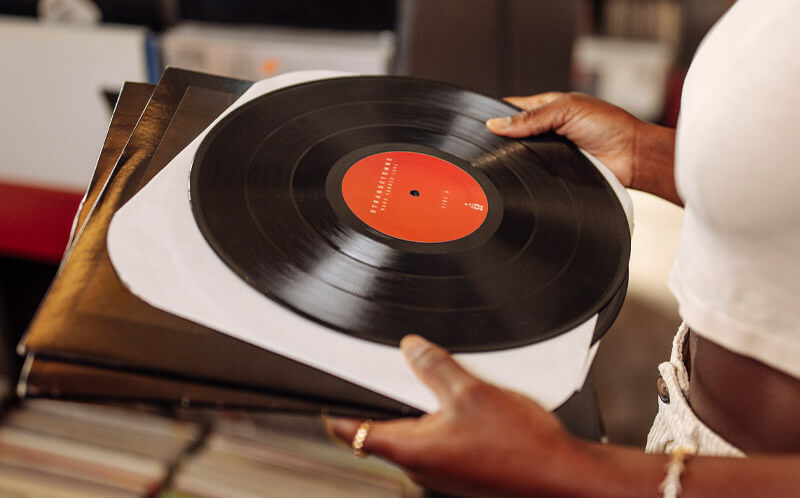
Somewhere in a garage, a spare bedroom, or the trunk of a car, 500 freshly-pressed records arrive, still sealed in shrink-wrap. Yet all you hear is the silence of a musician doing the math that they never signed up to do.
Lost in the excitement of holding the finished album and facing the reality of a credit card statement, one question elbows its way to the front of the line: How many of these do I actually have to sell before this stops being a hobby I paid for and starts being something that pays be back?
It's not the most glamorous of questions. Nobody's out there writing a song about break-even points, but it might be the single most useful number an independent artist can know, because it turns vague financial anxiety into a definite, achievable target. Once you know that number, you stop wondering whether or not you're "doing okay" and start knowing exactly where you stand, whether that's three sales away from even or thirty.
Thankfully, you don't have to turn your art into a spreadsheet. More often than not, the number you actually need is smaller and more achievable than what your anxiety is telling you. Let's do the math.
Break-even is easier than you think
Breaking it down into the actual equation, you get:
Total cost of the project divided by price per unit = the number of units you need to sell.
To illustrate, if pressing, printing, and packaging your run costs you $1,000 and youré selling each copy for $10, you need to sell 50 copies to get back to zero. Sell a 51st and you've started making a profit, however modest.
The problem comes when trying to get accurate, realistic numbers to plug into that equation, and that's where artists can get tripped up. They remember the manufacturing invoice but forget about mastering. They budget for vinyl but not the shipping to get it to the merch table. They price a record based on what seems right instead of actually doing the math. So with that in mind, before we talk about the number of units, we need to talk about the two variables that decide it:
1. What the record costs you
2. What you're charging for it
What a record actually costs you
Vinyl record pressing costs depend a lot on format, quantity and packaging choices. The good news is that the price per unit drops considerably as you order more. For CDs, Disc Makers' breakdown of CD replication costs shows just how much scale matters:
A basic CD in a jacket runs around $1.00 per disc at 100 units, but then drops to $0.80 per disc at 2,500 units, then falls to $0.70 per disc at 5,000 units. That's before factoring in inserts, digipaks, or premium packaging, all of which raise the per-unit cost but can also raise what you're able to charge.
Vinyl tells a different story, because the economics of pressing records are still catching up to the new demand for them. When selling vinyl and CDs, a 100-unit vinyl order runs around $10 to $15 per record, while increasing the number from anywhere from 300-500 units drops that number down anywhere from $5 to $7 per unit. Special features include colored vinyl, gatefold jackets, and more, and those should only be added if you already know fans are willing to pay more for special editions.
Understanding "what a record costs" also includes line items that are easy to forget about when you're looking at a vinyl pressing quote: mastering, artwork, layout, proofing, shipping to your door and, if you're selling in person, the gas or shipping costs of getting inventory to the show.
None of these costs are exorbitant in and of themselves, but skipping them is how artists end up thinking they've broken even when they haven't. If you want your break-even number to mean anything, it has to include everything you spend, not just the biggest invoice.
What to charge for vinyl records
On one hand, you want your pricing to match what's out there. You want to charge what feels fair, match what other bands charge, and so on, but there's more structure to it than most artists will tell you.
Disc Makers' Guide to Pricing your CD lays out several pricing strategies worth understanding. Even if you don't use all of them, costs-based pricing (starting from your total costs and adding a margin), competitive pricing (what similar artists in your genre and market charge) and value-based pricing (price according to what your audience thinks your music and packaging is worth) are ones to pay special attention to.
In practice, most independent artists end up combining all three. For example, CDs sold at concerts commonly cost around $10, though many artists can easily charge $12-15 and still get a long line at the merch table. CDs in retail settings are higher, often $12-18. Vinyl tends to fall in the $20-35 range while retail vinyl can go as high as $40 or more. That number accurately reflects the higher production cost and the format's premium feel in the eyes of buyers and collectors.
Price is psychological as well. A $10 CD isn't just an easy impulse buy – the math actually works out for you. If a CD costs you $2 to make, that $10 sale is an 80% profit margin. Vinyl margins are thinner, usually anywhere from 40-60%, which is also why many artists price vinyl higher, even if sales are slower to start.
However you ultimately decide, do so deliberately since this is one of only two numbers in the break-even question, and it matters just as much as the cost side does.
Running the numbers
This is the satisfying part, because once you have real costs and a real price, the math itself takes thirty seconds. Let's say you press 100 CDs for $200. That price only covers the manufacturing. If you sell those CDs at $10 each, you need to sell 20 copies to break even. If you sell through the full run, you've turned a $200 outlay into $800 which is a strong return for a physical product in 2026. Price the same CDs at $15 and you only need 14 sales to break even.
Vinyl has a bigger price tag but the math can still even out well. If 100 records cost you $1,300 to press and package and you sell them at $25 each, you'd need to sell 52 records to break even, just over half your run. That's a bigger lift than the CD example, but that's also why many artists use vinyl pre-orders to fund the pressing cost before the records are even delivered. In this way, you avoid the post-release scramble and pull from money that has already been banked.
Try it with your own numbers before you commit to a specific pressing run size. Disc Makers offers a free online quote for vinyl, CDs and more where you can plug in your actual manufacturing needs, along with the extras like mastering, art, and shipping, and get a quote as well as optionally start the process.
The mistakes that blow up the math
Sometimes, even when artists do the break-even calculations, they still end up getting burned because of a few predictable blind spots, namely:
Confusing revenue with profit
Selling out a run of 100 CDs at $10 each is $1000 in revenue which sounds like an undeniable success, but if you haven't subtracted your costs, you don't know if you've actually broken even or made money. It's an easy trap to fall into because it's addictive to watch revenue climb. Profit requires the slightly more irritating step of subtraction, so it's not as much of a thrill, but still necessary.
Break-even is a moving target
Many artists forget that break-even can be a moving target if you're also paying yourself back for time. If you're trying to handle the mixing and mastering yourself, designing your own artwork, and handling both the technical and creative sides yourself, those aren't even part of the manufacturing break-even calculation.
That's why Disc Makers makes it easy to have additional services like mixing, mastering and cover art design handled for you. Our creative portfolio has plenty of samples to browse, and our SoundLAB offers complete mastering services, giving you one less thing to worry about when you're adding it all together.
Where you sell changes how fast you profit
The same 100 records can sell out in a weekend or take an entire year, depending entirely on where they're being sold. This is the part of the equation that's easy to overlook because there's no dollar figure attached to it, but it still directly determines how quickly your break-even number goes from basic math to money in your pocket.
Live shows are still one of the best places to sell physical music. You've got the emotional power of a great set, which itself feeds into a $20 vinyl purchase as a natural extension of the whole experience. We've got plenty of veteran advice for selling merch at concerts. T-shirts remain the top seller, but posters and vinyl records are consistently popular add-ons.
To boil it down to practical advice: a well-lit table in a high-traffic spot, with clear and visible pricing and multiple items at different price points can move a lot of merchandise. Plus, in this way, a fan on a budget can still come away with something memorable. Factor in a smooth checkout process that tasks cash or card without creating a massive line of waiting fans, and you'll be able to see how easy it can be to move units and make sales.
Competing against streaming services
One of the core questions you're likely going to ask yourself is not just how many records you need to sell to break even, but how to compete against streaming services. Streaming has trained fans to expect music to be practically free, which means a physical record has to justify itself as more than just a copy of the songs. That could be anything from a keepsake design to a piece of merch or some other way to directly support someone whose music they enjoy. This is obvious when selling in person, but selling online begs the question, "Why buy this instead of streaming it?"
The good news is that fans have already answered that question at scale, which is worth keeping in mind when you start second-guessing whether or not anyone will pay $25 for a record they could stream for free. Vinyl sales trends show that vinyl has grown for 16 consecutive years and have outsold CDs for the first time since 1988. U.S. consumers spent $1.2 billion on vinyl in 2022 alone, which in itself was a 20% jump from the year before. That's not just in niche genres – it's one format actively winning against the convenience and ease of streaming. Who says physical formats are obsolete?
So what makes vinyl more desirable than streaming? The answer matches perfectly with the idea behind why vinyl is worth pricing at well above its manufacturing cost: it's something to display, not just play. Having a large, visually-unique object to show does something that a phone screen can't. Getting a record ready to play is a small ritual that rewards listening and focus in a way that just tapping "play" can't.
What's more, a large chunk of these buyers know precisely what they're doing when they hand over $25 for a record: they're choosing vinyl specifically because it puts more money directly in the artist's pocket. Interestingly, a majority of Gen Z vinyl buyers don't even own a turntable. The point for many of them isn't about audio fidelity itself, but rather owning a piece of something they care about, and supporting the person who made it. That's a much different transaction than a stream, and that's why vinyl can command more than competing against something that's practically free.
Funding the run before you're stuck holding it
If you're looking for ways to shrink your break-even risk, one of the most underused methods is reducing the size of the bet before you place it. If a big pressing run makes the price-per-unit attractive, but you're worried about whether or not you can move enough units, there's a middle path – raise some of all of the manufacturing cost before you press.
Disc Makers offers a complete guide to funding music projects to help artists understand exactly how to do this, step by step. There are plenty of crowdfunding platforms that let fans pre-order and effectively fund the pressing run in exchange for getting the record early. Other options include small grants from local arts organizations, and for artists who have a somewhat established name and are growing, there are angel investors or labels who can bring capital and connections in exchange for a share of the return.
Each one has its own pros and cons. Crowdfunding does mean you'll need to do outreach work upfront, but you get to keep full creative control. Grants are close to free money, but you have to make a case for community or artistic value, not just have a good sales pitch. Investors and labels can cut out a large chunk of risk on release, but they expect their money back with a little something extra.
The point is that if you pre-sell 40 vinyl records through a crowdfunding campaign before you press 100, you've already covered a big chunk of your break-even number before the boxes even arrive at your doorstep. You're simply moving the timing of the sales you were going to make anyway.
Records shouldn't be the whole business model
Keep in mind that in 2026, record sales aren't going to be the primary source of income, and treating break-even as the only measurements of a release's success sets up a mismatch between what records are good at versus your expectations for them. For most artists, the business model is a pie chart of streaming royalties, licensing and sync placements, teaching and/or touring. Physical media is nestled inside that mix rather than standing apart from it.
Where vinyl earns its keep isn't as much about volume as it is about the things they represent: Something a fan can hold, display, and associate with a specific memory or a connection to your music. That in and of itself has a different kind of value than a stream, and it's why the margins on physical products tend to be so favorable compared to streaming payouts. A record sale in and of itself isn't the real finish line anymore than a single local show is a reason to stop touring. One record sale leads to another, then another, and then a dozen more.
Pulling it all together
If there's one habit you come away with after reading this article, it's doing the break-even math before you even place an order. Get an actual manufacturing quote from a company that specializes in vinyl pressing, like Disc Makers. Factor in additional costs like mastering, art, and shipping. Decide on a price that isn't "going with your gut." Divide the total cost by price to get your break-even number.
Then look at that number honestly against your existing mailing list or social media followers, your average show turnout, your touring plans and other avenues to see whether or not it's a realistic number for the timeframe that matters to you.
The answer may very well be to press fewer units at a slightly higher cost-per-unit so that your break-even number is lower and less nerve-wracking, especially if it's your first time getting vinyl pressed. The answer may also be to raise some of the money in advance via pre-orders and crowdfunding. Sometimes it means confirming that yes, the math works, and pressing 300 records is a solid bet given how many people show up to your shows.
Whatever that answer may be, knowing your break-even number changes your relationship to the whole project. You stop measuring success in terms of "I'll know I made it when I do X." Instead, you start measuring it against a real target that doesn't rely on vague numbers.
The best part is that once you cross it, whether that's on sale number 10 or sale number 50, everything beyond that point is the reward for having something people truly enjoyed and connected with enough to want to pay for. It's a good problem to have, and one that only comes about once you've done the math.
It also affects how you talk about the release with your bandmates or collaborators. That matters more than it seems. Saying, "We need to sell 40 more to break even" creates a shared, solid goal that a whole band can rally around everywhere from merch tables to group chats. Numbers give you something real to point to when it's time to make sure the work paid for itself. Even if it's a modest pressing run, that moment of closure is worth having, and worth celebrating.
None of this needs any specific software or deep financial expertise to make it happen. With the Disc Makers online quote too, a calculator, and an honest breakdown of what you're actually spending, you'll be able to get that number in just a few minutes.
The excitement and anticipation of a new release might be whispering in your ear telling you to just go with your gut and wing it, but do the math anyway. Future you, staring at that box of records in the garage or on the trunk of your car and wondering how you're doing, will already have the answer. Get started today with a free quote from DiscMakers.com.