



How many vinyl records should I press?
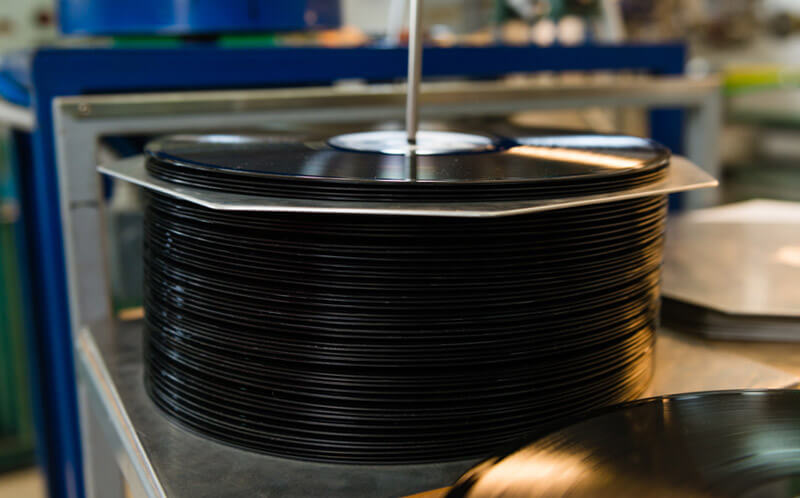
You're getting ready to launch your new special edition vinyl records. You open up the order form and see the quantity field sitting there, waiting for a number. You think, how many vinyl records should I press? One hundred? Three hundred? It looks like a simple form field, but it's really a bet that you make months before the record actually exists that asks: How many people want to own something they haven't heard yet?
If you guess too low, you're the artist re-ordering at a worse per-unit price two weeks after selling out at your record release show, watching the excitement go up in smoke while you wait for a second pressing. If you guess too high, you're suddenly the artist with 340 records still living in a closet eighteen months later, turning that space into the world's least profitable storage unit.
Both of these results are entirely avoidable, and the difference between them isn't just a lucky guess. The secret is to make sure the number came from an actual read of your sales channels and your break-even math, rather than a gut feeling of "this seems about right."
Remember the minimum order
Before we get into pricing and strategy, it's worth noting that the choice of "How many vinyl records should I press?" isn't infinitely open in either direction. Most vinyl pressing specialists require a minimum order. At Disc Makers, we require a minimum of 100 units per title. Why that specific number? As vinyl pressing specialists, the setup costs of cutting a lacquer and creating a stamper are fixed regardless of the run size, so anything smaller than 100 units doesn't make sense for us or you.
This makes things easier for you, the artist, since now the question becomes "What number above 100 does it make sense to land on?" It's also helpful if you're worried about ordering too few vinyl presses for a debut release. One hundred records is the industry's own starting point, as our guide on short-run vinyl pressing will tell you. That whole category exists so that independent artists can put out a professional, well-manufactured record without needing the budget of a much bigger release.
Do the break-even math
The single most important and useful thing you can do before you choose a vinyl record quantity is to do the break-even math. We've even made it easier thanks to a detailed breakdown of vinyl economics, including this helpful example:
100 12-inch LPs in black vinyl with printed jackets comes to $999, and once you add a UPC barcode and shipping, the realistic all-in cost lands around $1,169 or $11.69 per record. Sell these records at $25 each and you're clearing more than $13 in profit per unit.
That's a margin above 50%, which means you only need to sell 47 records to fully recover your cost. The other 53, assuming you sell through the entire run, are pure profit.
In that same guide, you can also learn how the per-unit math changes as you scale the order, going from around $11.69 per record at 100 units, to $8.80 at 200, and closer to $7.60 at 300. We know it's tempting to look at that curve and immediately think bigger is better since the cost per record keeps getting lower – but it only works if you manage to sell through that many.
If it takes you two years to move through 300 records, the cost is worse, both financially and logistically, than paying a higher per-unit cost on 100 records that you sell out in a month. The discount works best when you know your sales channels can handle it.
For double LPs, you'd follow the same logic but at a different scale. Disc Makers' double LP pressing at 100 units as part of a standard run costs $1,999, which is about $20 per record. Selling just 50 of these covers the full cost of production, and the remaining half represents just over $2,000 in potential profit if you sell out the whole run.
What this means is that the decision doesn't change just because the format does. Figure out your real price, and let the break-even number tell you how big of a bet you're actually making at a given quantity.
Map your sales channels
Now, the break-even math will tell you how many units you need to sell before you make a profit, but it won't tell you whether or not you can actually sell that many. That second question trips up many independent artists, and the way to avoid mistakes when asking "How many vinyl records should I press?" is to work backwards from your actual audience rather than forward from a price list.
Disc Makers' guide to pressing vinyl outlines your exact next steps by breaking down every channel you should be using, including: merch table, online store, direct-to-fan platforms, and so on. We recommend choosing a quantity that matches what those channels can plausibly move. If you're ordering other types of physical music, our guide on how many CDs to order is also worth a look.
When a bigger run gets you more than just a lower per-unit cost
Beyond just expecting to sell more, there's another reason to size up to a bigger run. It might sound counterintuitive, but choosing a short run vinyl provider doesn't mean you have to compromise on sound. In some respects, it's the opposite.
If you've ever wondered why short-run vinyl sounds the way it does, the reasoning is simple. Orders of under 500 copies use one-step plating, which means that they're pressed directly from the first-generation metal rather than a multi-generation stamper chain that larger runs need. Because stampers wear down the more they're used, an order in the 100 to 300 range comes from a stamper that's at the very beginning of its life, when grooves are at their sharpest.
That means a short run isn't just less risk financially, it also means that the results can sound genuinely crisper and sharper than a large commercial pressing run that uses a stamper that's further along in its lifecycle. Choosing a smaller run isn't just a cautious option for first-time vinyl release artists, but it could very well be the better-sounding option too.
If you're deciding whether or not to press more vinyl records, it makes sense to do so only when you have the concrete evidence to back it up, such as pre-orders, a strong mailing list, and/or a track record from a previous release. With those channels in mind, you'll know that the extra units you order will actually leave the shelf and not sit there collecting dust.
Retail, limited editions, and running the numbers
If the question of "How many vinyl records should I press" has crossed your mind with regard to retail, or limited editions, you're in luck. If you want your record in physical stores, the math changes because a distributor or retailer isn't going to be buying one individual copy at a time.
Disc Makers has created a complete guide to custom and limited-edition vinyl, and we recommend pressing at least 300 units if retail is a part of your plan. Anything smaller than that can struggle to give you the "shelf presence" you need for a store or distributor to justify carrying your record in the first place.
That same guide is also a helpful reminder that pricing and quantity are linked together. Calculate your true break-even cost per unit, and then price at roughly double that figure to build in a healthy margin once the retailer and distributor take their cuts off the top.
If your goal is the opposite — a limited edition run designed to feel unique rather than sit on retail shelves everywhere — having a smaller number is the whole point. Our same guide to custom and limited-edition vinyl notes that 100 units is a good size for a limited release.
What's more, tighter runs are tied directly to scarcity – with a smaller pressing, you've cultivated a sense of urgency and exclusivity that a larger, more available run simply can't mimic. Ordering more undercuts your actual goal. Knowing which of the two you really want – either broad availability or manufactured scarcity, should come before you choose the quantity.
Lowering the risk of the number you land on
If you've done the math and still landed on a quantity that feels like a stretch, there's a proven way to shrink the risk even further before you commit: sell some of the run before it exists. Pre-orders and crowdfunding let fans fund part or all of a pressing run in exchange for getting the record first. That turns a chunk of your break-even number into money you already have in hand rather than something you're merely hoping for.
If you're interested in learning more about funding music projects, Disc Makers has a lot more information where that came from, including other funding options like grants and investors. It doesn't even have to be a massive, glitzy crowdfunding campaign, either. It can be something as simple as a two-week preorder campaign that's in line with your launch announcement. If you sell 60 of the 100 records you're considering before you ever even order, you've already got your answer as to whether or not 100 was the right quantity.
Even if you don't need fans to cover a large part of the manufacturing, pre-sales orders can still give you a bit of a glimpse into what your fans truly want. If the numbers for pre-orders are beyond what you expected, it's better to know that two weeks before you place your order than two months after the boxes arrive at your door.
Keep turnaround time in mind
It's easy to leave turnaround time out of the mix entirely. If you're wondering not just how many vinyl records to press, but how long it takes, here's your answer. Standard turnaround times on a vinyl pressing order take around 7–9 weeks. Faster options are available but there's no guarantee they'll line up with your release date if you need them on short notice.
It's not as simple as "if you sell out, just order more and you'll get them the same week." There's a two-month period at a minimum, during which you won't have any physical product to sell at the moment when demand is highest, such as right after a release, after a high-profile media review, or in the middle of a tour.
For this reason, we recommend pushing your quantity slightly higher than your most likely sales estimate, instead of lower. If your best guess is that you'll sell 150 records in the first three months, ordering exactly 150 means any sudden streak of luck, like a playlist placement, a surprise sync placement or a bigger-than-expected crowd, turns into weeks of missed sales while a re-press is happening. That's why it's a smart idea to pad a run by 20-30% more than your main estimate. Think of it as insurance against a stockout that's not quickly fixable. Remember, a sold-out record is a good problem to have, but if it happens, it happens because demand outran a reasonable estimate, not because that estimate was cut too close.
How to avoid second-guessing the quantity
There are some patterns that continually reappear when artists ask themselves how many vinyl records to press. Most of these patterns can be traced back to optimizing for the wrong thing. Here's how to sidestep them so that you don't get caught with too few, or too many.
Chasing the per-unit discount
A price list that shows $11.69 at 100 units and $7.60 at 300 makes 300 look like the obviously smarter choice, but that's only true if you can move 300 in a reasonable timeframe, otherwise the savings just become money that's tied up in unsold inventory, as well as whatever it costs to store, protect, and discount the extras.
Ordering for the release show instead of the release cycle
This is a common mistake that happens simply because it's natural to size a pressing around a single high-visibility event. The truth is that a record's real sales life can run for months or years later through your online store, future shows, and word of mouth. Sizing purely for a single event either leaves you short right away, or overestimates how fast the remaining stock will move once the initial excitement fades.
Skipping the sales-channel math
Independent artists will often skip the sales-channel math because the break-even alone looked comfortable. A 47-unit break-even point on a 100-unit run sounds safe on its own, but it's still assuming you've got a workable way to sell 47 records. If your audience numbers and show attendance don't support that assumption, the break-even math was solved for the wrong problem.
A second pressing is always available
Even if you do happen to undersell your own demand, that can be corrected in a matter of weeks with a reorder. Overestimating one, on the other hand, can take much longer to work off. If you're torn between two quantities, the lower one is usually the safest in order to avoid risk.
Let your last release set the baseline for your next release
If this isn't your first pressing, you may not realize it, but you already have the single best data source for this decision, sitting right there in your sales history. It's worth using that information before falling back on basic industry benchmarks. Take a look at the details: How long did your last run actually take to sell through, and which channels worked? If 100 copies of your last EP took 14 months to sell and mostly moved through your online store rather than live shows, that's a much more reliable signal for this release than any guide about what a typical independent artist sells.
Likewise, if you sold out a smaller run in six weeks and spent months fielding "do you have any more?" messages, you've now got the same information, just in the opposite direction. Also consider what changed and what didn't during releases. Have you grown your mailing list? Do you have a larger streaming audience? A fuller touring schedule? Those are real reasons to add more to the quantity than you did in your previous run.
At the same time, releasing during a quieter stretch or putting out a companion single rather than a full album, are reasons to hold steady or size down. Your last number isn't automatically right for this particular release, but it does give you real evidence, which beats a benchmark built from other artists' catalogs any day.
Landing on the right number
There is no "one size fits all" answer to "How many vinyl records should I press," but there is a process for finding your own number: Start from the minimum order floor of 100 units, work out your real break-even point using an actual price and cost, and then match that with what your actual sales channels can honestly move in the first year.
From there, decide whether the goal is always-on availability or engineered scarcity. Whatever decisions you make at that stage can swing the right number considerably. If you're looking at that number and you still feel unsure, consider a pre-order window through crowdfunding or another pre-selling process. Running out is a solvable problem. Pressing a record you're confident you can sell out is a better outcome than pressing one you can't, even if that smaller number means you have to pay a little more per unit.
None of this needs a background in finance or math to get through. What you must do, however, is go through the steps before you place the order rather than after, since that's the only time where the answer can change the number you enter. Once the pressing plant has the quantity, the number you picked is locked in, which is why it's worth getting right the first time.
How Disc Makers can help
Thankfully, you don't need to stare at a blank spreadsheet and hope that a list of industry averages is enough to help you figure out your number. Disc Makers' online quote tool lets you price out real quantities, from a 100-unit vinyl short-run up through five-figure orders for your specific format, jacket style and color choice.
Run the break-even math in this guide against the actual numbers for your release rather than the general examples shown here. Because short runs of 100-500 records are common, you can start out conservative and increase quantity or consider a second pressing once you've seen the real numbers and how they line up with your budget.
Because we know vinyl pressing, it can also help to have people working with you who quote vinyl orders every day. If you're weighing a standard LP against a double LP, deciding whether 300 units clears the bar for the retail interest you've got, or you're trying to figure out how a colored-vinyl upgrade changes your break-even number, help is here. Disc Makers' experienced team of vinyl pressing professionals can walk through the specifics with you directly as part of the online quote process. That means in no time at all, you can go from a general one-size-fits-all formula, to a number that's sized to your actual release.
Try Disc Makers' online quote tool now or review our other helpful articles for information on the pricing and economics behind vinyl pressing. Then see the numbers for yourself and get ready for your first, or next, release.